Trust Collapse: Why AI Fraud Is Financial Services’ Blind Spot
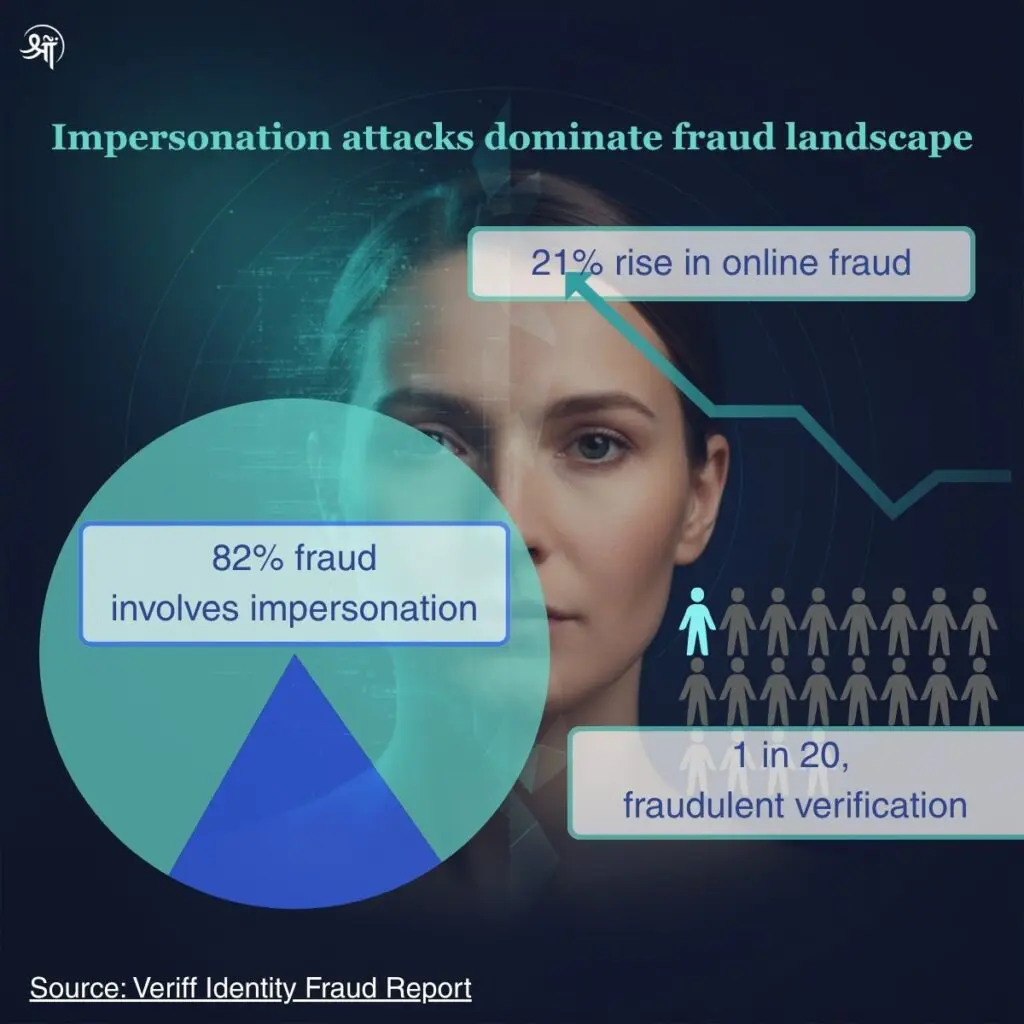
Every organisation I’m currently working with, is re-evaluating its exposure to digital fraud. The data is broadly consistent across the industry, but Veriff’s Identity Fraud Report quantifies it clearly.
It captures how fraud has scaled, and where defences are falling short.
Online fraud increased by 21% year-on-year
The ratio of fraudulent to genuine verification attempts is 1 in 20.
More than 82% involve impersonation, driven by the proliferation of generative AI tools that automate fake identities and bypass biometric verifications.
This is a clear departure from opportunistic scams to structured, technology-enabled crime. Attackers use tools that imitate real devices, inject synthetic data, and manipulate verification processes with precision. They are not breaking into systems; they are replicating them.
For banks, these trends are a turning point. Detection tools and compliance controls remain essential, but they have to deal with synthetic identities that move faster than counter-fraud responses can adapt. Resilience, therefore, will depend on continuous verification, multi-modal biometrics, and visibility across the broader financial ecosystem, not on siloed defences.
The deepfake dividend
Veriff’s report notes a sharp rise in AI-generated mediabeing used to fake identities, during onboarding and authentication.
The forged artefacts used to bypass these checks blend multiple techniques including synthetic voices, deepfake videos, altered documents, and data injections, to create convincing digital replicas of legitimate users. And the whole process is automated, also using AI, providing unprecedented scale.
End result is what I call the deepfake dividend, a compounding return on investment for criminals. What once required skill and effort is now scalable, accessible, and inexpensive. The barrier to entry for complex fraud has collapsed.
This convergence of AI capability and criminal intent is transforming the risk landscape. Current verification systems face AI-generated media that looks and behaves like the real version. Even advanced liveness checks fail when synthetic data enters directly into verification streams.
For financial leaders, the question shifts from fraud prevention to fraud prediction, anticipating how generative technologies will next be used to simulate authentic identity.
Synthetic identities and emulator attacks
Fraud has evolved from exploiting verification processes to exploiting the systems that power them. Fake identities, built from fragments of real and artificial data, are used to pass automated checks at scale. They are engineered to fit the expected data patterns of real users, consistent enough to appear genuine, yet flexible enough to avoid detection.
Attackers use tools, emulators, that mimic real devices and user activity. They then run thousands of fake sessions in parallel. Other tools inject synthetic data straight into verification systems, bypassing visual or biometric steps altogether. This level of automation removes friction and allows fraud to operate with speed and scale once unimaginable.
Veriff reports that emulator and injection-based attacks increased significantly through 2024, along with a 46% rise in adversary-in-the-middle (AiTM) incidents.
Such hybrid attacks exploit gaps between identity systems and financial applications. The scale of this activity represents a shift from isolated instances to continuous infrastructure-level exploitation.
Implications on financial services
Identity fraud has become a systemic risk across banking, fintech, and commerce. It is an operational pressure that influences customer onboarding, compliance costs, and regulatory exposure.
Financial services remain the most targeted sector in Veriff’s report, accounting for over 13% of all global fraud attempts.
The drive for speed and seamless experience has expanded the attack surface, giving criminals new entry points. A single compromised verification can cascade through connected platforms within seconds.
The cost goes beyond financial loss. Synthetic identities distort credit portfolios, pollute KYC databases, and weaken the reliability of transaction monitoring. Repeated compromises turn fraud from a compliance issue into a market-integrity problem.
Automation can handle verification at scale, but it cannot define trust signals that should be used to determine authenticity.
That judgement lies with people; the policy makers, the product managers, and the risk officers who design and manage these systems. Awareness, in this context, means informed decision-making: knowing when to adjust thresholds, increase friction, or question the logic of the verification flow itself.
The data indicates a need for greater collaboration across organisations. No single entity can counter attacks that move freely between platforms. Shared intelligence, stronger identity standards, and coordinated regulation are essential to restoring confidence in digital transactions.
Identity assurance is as fundamental to financial stability as capital adequacy. Institutions that treat verification as a strategic capability will be better equipped to manage the scale and speed of modern fraud.
The resilience imperative
Digitisation and AI innovation have redefined the economics of fraud. As identity systems expand, so do the opportunities for exploitation. Controls will always be tested, but what matters is how quickly organisations can adapt.
Resilience means building verification ecosystems that learn from every attempt and share intelligence across networks. Fraud patterns evolve faster than bi-annual risk reviews, demanding continuous alignment between automated systems and the people who shape them.
Technology can execute, but people decide how trust is built and maintained. When informed decision-makers interpret anomalies, refine thresholds, and strengthen processes, detection becomes resilience.
The story is simple. Fraud is scaling faster than defence. Institutions that thrive will be those able to match the speed, precision, and coordination of their adversaries.